

A Judgment for Possession is a court order from the Ontario Superior Court of Justice that confirms the debt a mortgage lender is owed and gives the lender the legal right to take possession of the property. It is granted after the lender’s Statement of Claim and comes directly before the Writ of Possession that leads to eviction.
In Ontario’s Power of Sale process, receiving this judgement means the court case is over and the lender has won — usually without a trial. What remains is enforcement: the Writ of Possession and the sheriff’s eviction. If you have received one, you still have options, but the window to act is short. Our guide on how to stop a power of sale in Ontario covers the full range of solutions.
How a Lender Obtains a Judgment for Possession
The judgment is the outcome of a lawsuit. The lender starts a court action by issuing a Statement of Claim, which is served on the homeowner and anyone else with an interest in the property. From the day you are served, you generally have 20 days to file a Statement of Defence. Our guide on whether to file a Statement of Defence for your mortgage explains when defending makes sense.
In most Power of Sale cases, no defence is filed. The lender then notes the homeowner in default and obtains a default judgment — no trial is held, and many homeowners first learn of the judgment when it arrives in the mail. If a defence is filed, the case becomes contested and the lender typically has to bring a motion before a judgment is granted, which adds time but also legal costs that are ultimately charged back to the mortgage.
What the Judgment Document Contains
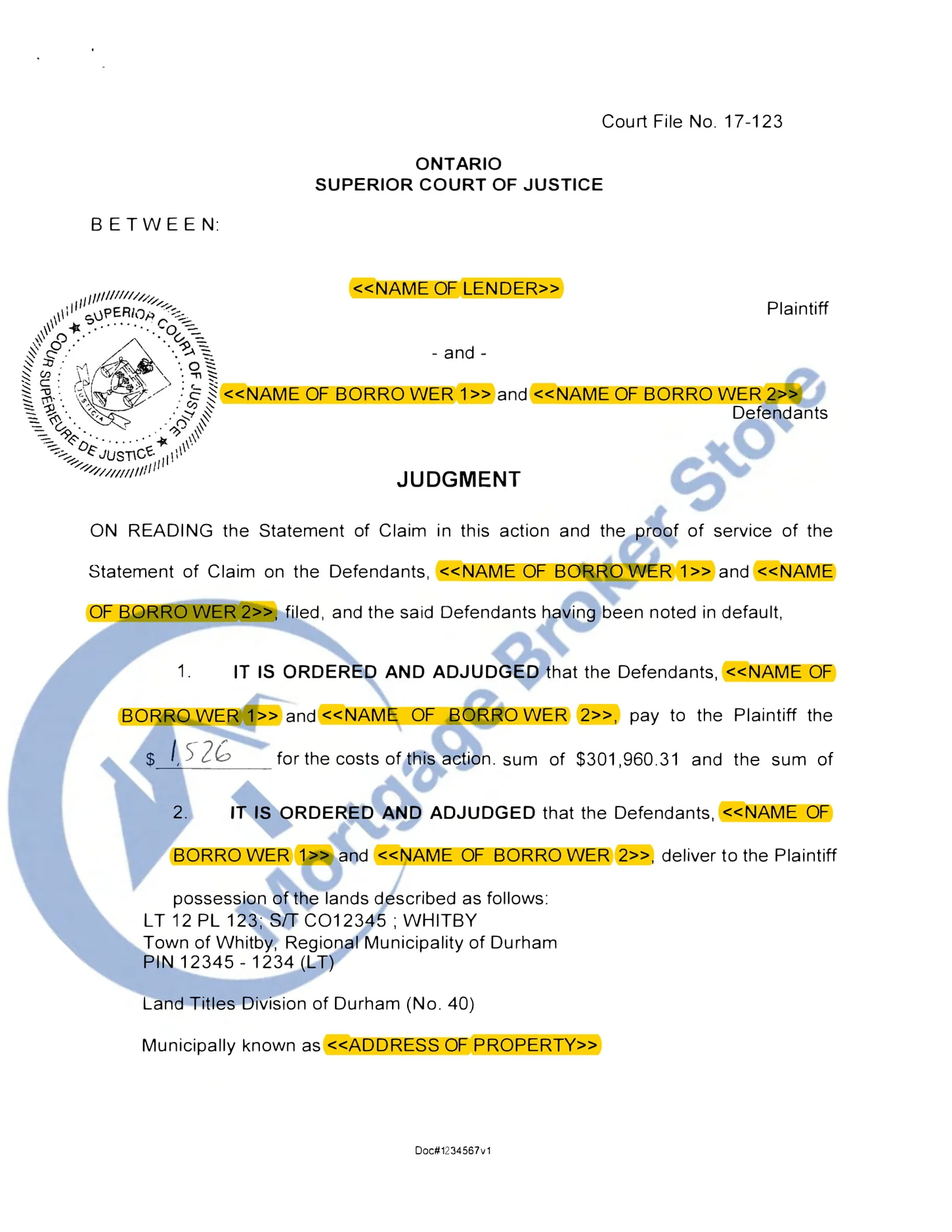
The document is easy to identify: the word “Judgment” appears in large bold letters near the top, along with the court file number and the courthouse that issued it. It names the lender as plaintiff and the homeowner (and any other borrowers or guarantors) as defendants, states the amount the court has found owing — principal, interest, and legal costs — and orders that the lender recover possession of the property. To see what one looks like, review our real example of an Ontario Judgment for Possession — the first page is shown above.
What Happens After a Judgment for Possession
In many Power of Sale cases, the homeowner does not file a Statement of Defence, and the lender obtains judgment by default under Rule 19 of Ontario’s Rules of Civil Procedure1. After Judgment for Possession is granted, the courts will issue a Writ of Possession2 to all parties interested in the property. This includes the property’s occupants, owners, and all lenders. The Writ of Possession is also sent to the local sheriff’s office3, which will arrange for a day and time to evict the property’s occupants and give the lender stated in the Writ of Possession control of the property. Once the lender has control of the property, they will list it for sale using a licensed real estate agent. When the property is sold the mortgages registered against the property are paid off in the order in which they were registered. Any excess profits after debts have been paid off go to the homeowner. However, this usually isn’t much, and all fees are deducted. For a full breakdown of the writ of possession stage — including how long you have and the ways to stop it — see our dedicated guide.
How long until the writ follows? There is no mandatory waiting period. The lender can ask the court to issue the Writ of Possession as soon as the judgment is granted, and it is often issued within days to a few weeks. The sheriff’s office then schedules the eviction, which typically adds another few weeks depending on how busy the local office is. In practice, a homeowner usually has only a matter of weeks from the judgment date before an eviction can be enforced.
Judgment for Possession vs Writ of Possession
The two documents are often confused, but they play different roles. The judgment is the court’s decision: it establishes that the lender is owed the money and has the right to possession. The writ is the enforcement tool issued afterwards — it is the document the sheriff actually acts on to carry out an eviction. A lender holding only a judgment cannot remove you from the home; the sheriff moves only once a writ has been issued and filed with the local sheriff’s office. That gap between the two documents is your last clear window to refinance, sell, or get legal advice before enforcement begins.
3 Ways to Respond to a Judgment for Possession
After the judgment is granted, the lender will not simply resume the old mortgage — most demand a full payout of everything owed, including fees. You must act before the property is sold. There are three main ways to respond:
- Pay out the mortgage with new financing. A new mortgage — often from a private or alternative lender, since banks rarely approve at this stage — pays the lender everything it is owed and ends the Power of Sale. In some cases the new mortgage also buys enough time for proper renovations and marketing of the property.
- Sell the property yourself. Selling on your own terms with a real estate agent almost always nets more than a lender-run sale, and any equity above the debts and fees stays with you.
- Get legal help. A lawyer may be able to negotiate with the lender’s counsel or, in limited circumstances, ask the court to set aside a default judgment — for example, if you were never properly served. Deadlines are tight, so speak to a professional immediately.
Whichever route you take, start immediately — once the sheriff enforces the writ, the lender controls the sale and your remaining equity shrinks with every fee added.
Important Legal Notice
The above information is general advice and it is strongly recommended to seek a legal professional when dealing with a Judgment of Possession in a Power of Sale scenario. A Power of Sale is a mortgage action under Rule 64 of Ontario’s Rules of Civil Procedure4 and can be a very complex legal process depending on the circumstances. Our team include lawyers who specialize in Power of Sales and real estate law. For a free consultation, please call 416-499-2122 or email jonathan@powerofsalesontario.ca.
References
- Rules of Civil Procedure, R.R.O. 1990, Reg. 194, Rule 19 — default proceedings and default judgments ↩︎
- Rules of Civil Procedure, R.R.O. 1990, Reg. 194, Rule 60.10 — issuing a writ of possession ↩︎
- Rules of Civil Procedure, R.R.O. 1990, Reg. 194, Rule 60.03 — enforcing an order for possession ↩︎
- Rules of Civil Procedure, R.R.O. 1990, Reg. 194, Rule 64 — mortgage actions ↩︎
Disclaimer: This page is for general informational purposes only and should not be taken as legal, financial, mortgage, or real estate advice. Power of sale and foreclosure matters can have serious consequences, and you should speak with a licensed mortgage professional, lawyer, or qualified advisor before making decisions. Power of Sales Ontario does not guarantee results, mortgage approval, or that the information on this page applies to your specific situation.