

Yes — a power of sale in Ontario can be stopped at any point before the sale closes. Depending on your situation, this may involve paying the arrears, refinancing, arranging a private mortgage, selling the property voluntarily, negotiating with the lender, or defending the claim in court. The sooner you act, the more options you have.
Our company has over a decade of experience working with homeowners in power of sale and foreclosure situations. If you have missed mortgage payments, received a Notice of Sale, or want to prevent an eviction, this page explains exactly what to do next. Power of sale can be a complex and time-sensitive process, and our company offers free consultations to those who call 416-499-2122.
What to Do in the Next 24–48 Hours
- Do not ignore the lender’s notice.
- Find out exactly how much is owed.
- Gather your mortgage statement, the Notice of Sale you received, property tax bill, income documents, and ID.
- Speak with a mortgage broker about refinance or private mortgage options.
- Contact a lawyer if legal enforcement has already started.
- Avoid waiting until the property is listed or sold.
Not sure what stage you are in? Call 416-499-2122 for a free consultation — we will confirm how far along the process is and which options are still open to you.
5 Ways to Stop a Power of Sale in Ontario
Most power of sale situations are resolved in one of five ways. The right option depends on how much equity you have, your income and credit, and how far the legal process has advanced.
1. Pay the Arrears or Refinance
If you are still within the redemption period set out in your Notice of Sale, paying all missing payments plus the lender’s fees is commonly referred to as “putting the mortgage back in good standing” — the mortgage resumes as usual and the process ends. Many homeowners sell possessions or take personal loans for this purpose. If the deadline has passed and the lender is demanding the entire mortgage balance, refinancing with a new lender can pay them out in full. If you have friends or family with money or property, their help — or leveraging their property to qualify for a new mortgage — is generally cheaper than working with third-party companies.
2. Take Out a Private Mortgage
Most banks and traditional lenders cannot approve a loan for a person already in power of sale. A mortgage from a private lender can be used to pay off the lender who is threatening the power of sale and stop the legal process. Private lenders specialize in high-risk lending and can overlook legal issues or issues with income and credit score. Rates will generally be between 8% and 12%, with fees between 3% and 6% of the loan amount, and most private lenders can approve a mortgage if the Loan-to-Value (LTV) ratio does not exceed 75%. Once the new mortgage is set up, the private lender can negotiate with the existing lenders and pay them directly to stop any legal actions.
3. Sell the Property Before the Lender Does
If you cannot be approved for alternative financing, selling your home before the lender takes it may be your best alternative. Before selling, consider: can you sell for a price that pays off all debts, and do you have enough time to sell the house? If you can get a firm purchase offer that pays off all mortgage debt, you may be able to stop the power of sale proceedings. It is strongly recommended to use a real estate agent who understands the power of sale process — a good agent can sell the property in its current condition, help you get a reasonable price, and ensure all debts and closing costs are paid at the end.
4. Negotiate With Your Lender
Most mortgage lenders want to work with their customers. They are primarily interested in the return on their investment and typically do not want the hassle and cost of legally evicting homeowners. A lender may be willing to offer a payment plan or deferred payments to help you get back on your feet — but you have to contact them, or their law firm once legal action has started, and ask.
5. Defend the Claim in Court
Every Statement of Claim informs you of the right to file a Statement of Defence. To succeed, you must give reasons why the claim is not correct — for example, the property address or owner’s name is wrong. Being unable to pay because of a layoff, or saying you did not receive the documents, is not considered a valid defence. Filing a defence can be expensive and time-consuming: it may buy a few extra weeks but cost thousands of dollars, and in many cases a mortgage-related defence is not accepted by the judge.
Often, homeowners are overwhelmed by the jargon and the options available. Professionals like those on our team can break down your situation and explain your best options. You can contact us for a free consultation at 416-499-2122 or by email at jonathan@powerofsalesontario.ca.
What Does Power of Sale Mean in Ontario?
Power of sale is the most commonly used method for mortgage lenders to recover their investment, created as a faster alternative to foreclosure. A lender can start a power of sale when the borrower has broken the terms of the mortgage agreement or failed to renew the mortgage. Most commonly this means missed monthly payments, but it can also result from failure to insure the property, causing substantial damage to it, or failure to pay property taxes.
Whatever the situation, the homeowner has full rights to the property up until the day of eviction. The homeowner is free to remortgage or sell the property while the power of sale process is ongoing. Once the property is sold, the former homeowner loses all rights to the property.
Power of Sale vs. Foreclosure in Ontario
Mortgage lenders in Ontario have two legal options when a borrower defaults, Power of Sale or Foreclosure. In a Power of Sale, the lender sells the property on the open market to pay off all debts. Once the property is sold, any excess profits must be given to the homeowner. This is very different from the Foreclosure process, which gives the lender title to the property and leaves nothing for the homeowner.
In Ontario, Power of Sale is the most commonly used legal process since it is generally faster and incurs fewer fees than foreclosure. If the Statement of Claim for your mortgage action1 says “Foreclosure,” then your property is in Foreclosure. If you do not see the word “Foreclosure,” then this claim will be a Power of Sale.
The Ontario Power of Sale Timeline
A typical Ontario power of sale takes 4 to 6 months from default to eviction, and every lender must follow the same legal sequence: a Notice of Sale2 after at least 15 days in default (followed by a 35 to 40 day waiting period3), a redemption period4 in which you can bring the mortgage back into good standing, a Statement of Claim5, judgment6 followed by a Notice of Possession and Writ of Possession7, and finally an eviction date set by the sheriff8. You also have the right to file a Statement of Defence9 in response to the claim. The further the process advances, the fewer options remain — and because the lender’s legal fees are charged back to your mortgage, waiting can add costs that exceed $30,000.
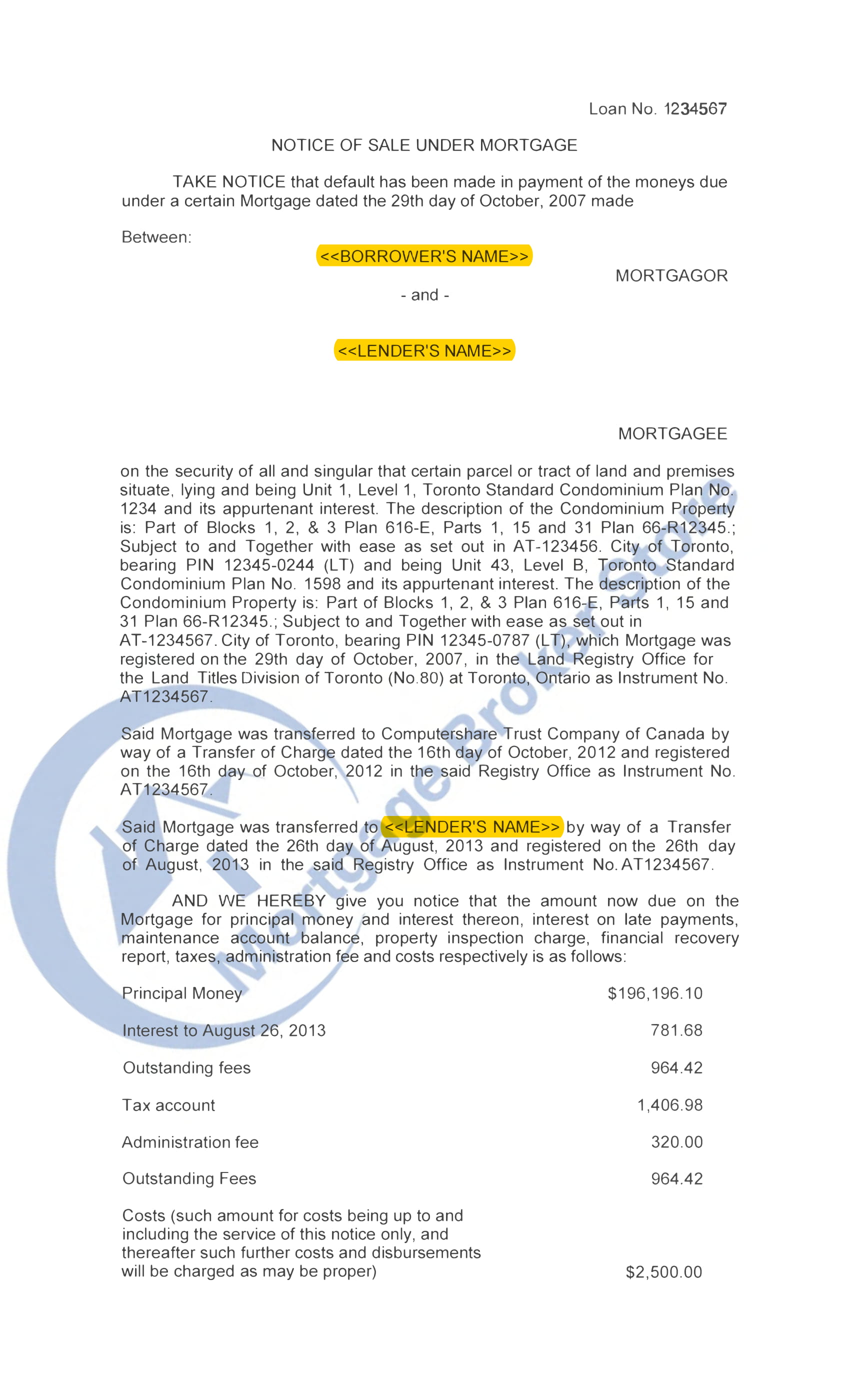
A sample of a Notice of Sale is below. The notice will state how much principal is owed and any other fees such as administration, inspection and legal fees.
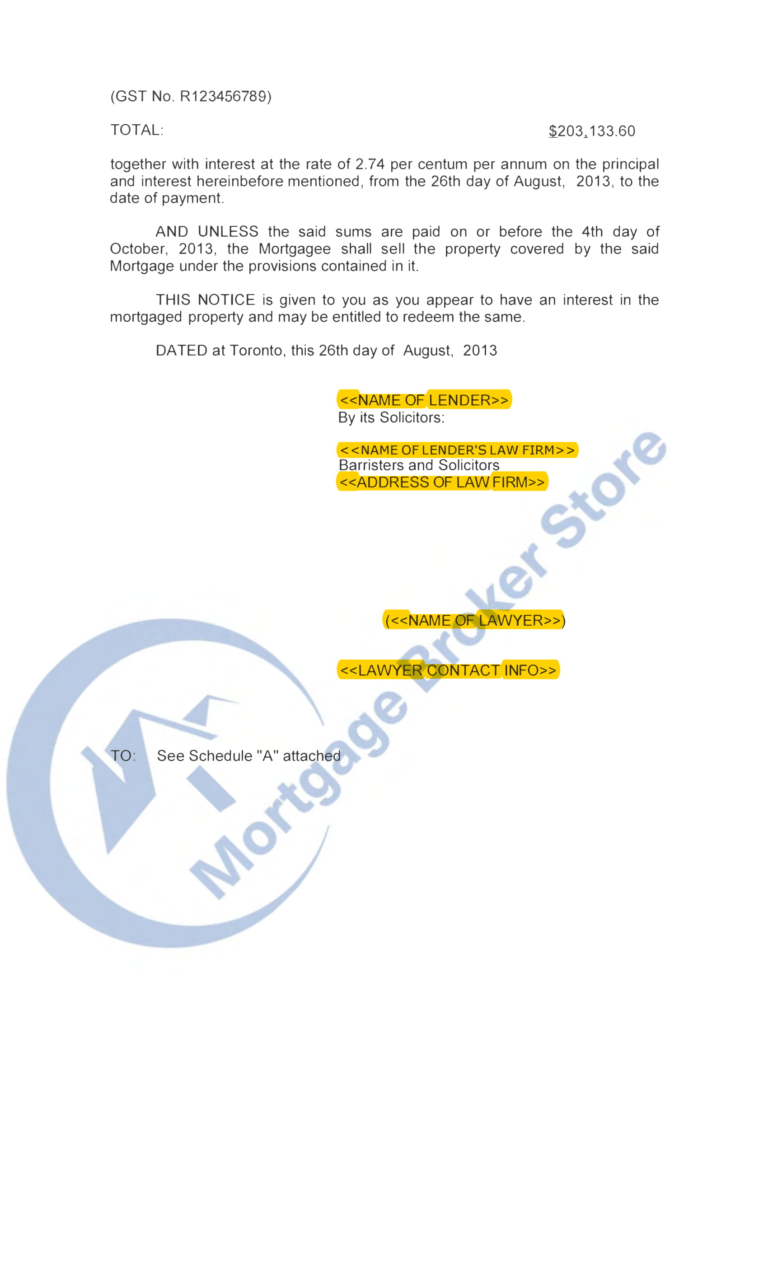
The notice also states the total amount owed and the payment deadline that marks the end of the redemption period, as in this example:
For an explanation of each document, deadline, and stage, read the full power of sale process, step by step.
What Are Your Rights During Power of Sale?
In the majority of cases, the best way to stop a power of sale involves paying the lender the money they are demanding. The lender should provide a discharge statement showing the amounts owed, with line items such as principal, mortgage arrears, penalties, and legal fees. We advise that the homeowner get a second opinion on the discharge statement to confirm that the fees are justified.
Even if you are evicted, you still own the house until it is sold, but your right to enter it becomes limited — you can usually only enter with the permission of the mortgage holder. We advise owners to remove all contents from the house before an eviction. You keep the right to sell the house after an eviction, but this is difficult in practice since you cannot easily show the house to potential buyers.
Advantages of Using a Mortgage Broker
Stopping a power of sale by yourself can be overwhelming, and a specialized mortgage broker can quickly lay out your options and identify the best lenders for your situation. Our team at Mortgage Broker Store has over a decade of experience in stopping power of sales and foreclosures and preventing evictions. We start by listening to your situation, confirming which stage of the process you are in, and giving you a timeline and possible solutions — including telling you quickly whether you can get approved for financing or are better off selling the property. For free advice, call our team at 416-499-2122 or email jonathan@powerofsalesontario.ca.
Need power of sale advice? Speak with us, and we’ll connect you directly with a Power of Sale lawyer you need. We have you covered. Call 416-499-2122 or email jonathan@powerofsalesontario.ca and gain expert advice! Please note that we are not lawyers and do not provide legal advice.
References
- Rules of Civil Procedure, R.R.O. 1990, Reg. 194, Rule 14 and Rule 64 — commencing a Statement of Claim and mortgage actions ↩︎
- Mortgages Act, R.S.O. 1990, c. M.40, ss. 31–33 — Notice of Sale timeline, form, and service ↩︎
- Family Law Act, R.S.O. 1990, c. F.3, ss. 21–22 — matrimonial home rights of married spouses ↩︎
- Mortgages Act, R.S.O. 1990, c. M.40, ss. 42–43 — proceedings during the notice period and redemption rights ↩︎
- Rules of Civil Procedure, R.R.O. 1990, Reg. 194, Rule 14 and Rule 64 — commencing a Statement of Claim and mortgage actions ↩︎
- Rules of Civil Procedure, R.R.O. 1990, Reg. 194, Rule 19 — default proceedings ↩︎
- Rules of Civil Procedure, R.R.O. 1990, Reg. 194, Rule 60.03 and Rule 60.10 — enforcement of possession orders and the Writ of Possession ↩︎
- Rules of Civil Procedure, R.R.O. 1990, Reg. 194, Rule 60.03 and Rule 60.10 — enforcement of possession orders and the Writ of Possession ↩︎
- Rules of Civil Procedure, R.R.O. 1990, Reg. 194, Rule 18.01 — deadline for delivering a Statement of Defence ↩︎
Disclaimer
Information regarding power of sale, foreclosure, and related legal processes is provided for educational purposes only and should not be relied upon as legal advice. Laws and procedures may change. Readers should consult a qualified lawyer regarding their specific situation.
Frequently Asked Questions (FAQ)
Get clear answers on stopping a power of sale in Ontario.
These common questions explain what to do after a Notice of Sale, how private mortgage options may help, and why acting quickly can protect more of your options.
How quickly can you help me stop a power of sale in Ontario?
We can review your situation quickly, confirm what stage you are in, and explain whether refinancing, a private mortgage, selling, or negotiation is the best option.
Can I stop a power of sale after receiving a Notice of Sale?
Yes, a power of sale can often be stopped after a Notice of Sale if you act quickly, pay the arrears, arrange financing, refinance, sell, or negotiate with the lender.
What does it cost to stop a power of sale with a private mortgage?
Private mortgage rates are generally 8% to 12%, with fees often between 3% and 6% of the loan amount, depending on equity and risk.
Can I stop a power of sale if I have bad credit?
Yes, private lenders may still consider you because they can often overlook credit problems and focus more on your property equity.
Can I stop a power of sale if I am self-employed?
Yes, private lenders may consider non-standard income, including freelance or contract income, when traditional lenders may not.
How does a second mortgage help stop power of sale?
A second mortgage can provide funds to pay the existing lender, settle arrears, and stop the legal process before the property is sold.
What documents do I need to stop a power of sale?
You should gather your mortgage statement, Notice of Sale, property tax bill, income documents, ID, and any other documents related to the power of sale.
Can I sell my house before the lender sells it?
Yes, homeowners can sell before the lender sells the property, and a firm offer that pays off the mortgage debt may stop the power of sale.
What areas of Ontario do you help with power of sale?
Power of Sales Ontario helps Ontario-based homeowners and has access to private mortgage options across the province.
Is it too late to stop power of sale if my home is already listed?
Not always, but your options become more limited once the property is listed, so you should act immediately before the property is sold.
Areas We Serve
We help homeowners stop power of sale and foreclosure across Ontario. Get local power of sale support in your city:
- Stop Power of Sale in Toronto
- Stop Power of Sale in Hamilton
- Stop Power of Sale in Brampton
- Stop Power of Sale in Burlington
- Stop Power of Sale in Oshawa
- Stop Power of Sale in Barrie
- Stop Power of Sale in Waterloo
- Stop Power of Sale in Niagara Falls
- Stop Power of Sale in Caledon
- Stop Power of Sale in Stouffville
View all cities we serve in Ontario or find your local Court Enforcement Office.
Google Reviews
What Our Clients Say
4.8 Based on 73 Google reviews
I had a quick call with Jonathan and was genuinely impressed by how knowledgeable, patient, and helpful he was. He took the time to listen to my situation and offered clear, tailored advice that made me feel more confident and informed about my next steps. It’s not easy to find someone who combines expertise with… Read more on Google
I found the website on google, looking for some information regarding a legal matter that I’ve never been involved with. Fortunately a quick conversation with Jonathan Alphonso put my mind at ease with all the questions and guidance that I needed to move forward. Thank you again Jonathan. I will continue to visit your website… Read more on Google
I reached out to Power of Sales Ontario and had pleasure of speaking with Jonathan Alphonso. His willingness to help me in a time where I didn’t understand or even where to begin was truly impressive. He answered my numerous questions over several encounters, providing me with extensive information; giving me a better perspective of… Read more on Google